blogger

Showing posts with label Password Crack. Show all posts

Thursday, August 9, 2012

Brutus

Brutus

This Windows-only cracker bangs against network services of remote systems trying to guess passwords by using a dictionary and permutations thereof. It supports HTTP, POP3, FTP, SMB, TELNET, IMAP, NNTP, and more. No source code is available. UNIX users should take a look at THC Hydra

Below is a screenshot of the main Brutus window in action. Brutus is running against a web server here using the HTTP basic authentication type. Brutus is going for the user admin using brute force to generate passwords (every 5 character combination using 'a-z'), the maximum number of passwords attempted will be just under 12 million. The status bar indicates that Brutus has attempted just over 1.16 million attempts and is running at an average speed of 501 attempts per second (that's over 30,000 per minute.) The worst case remaining execution time for this attack is just under six hours.

What is Brutus?

Many people refer to Brutus as a remote on-line password cracker, this is fairly accurate and I suppose it just about sums Brutus up.
Back to Top

What does it do?

Being a remote online password cracker, Brutus tends to crack passwords remotely, in an online fashion.
Back to Top

Is there any other software like Brutus?

There are more tools now than there were when Brutus was originally released, some tools of note include :
wwwhack  -  Offering HTTP, POP3 & FTP - generally nice and easy to use.
Entry - Offering HTTP, POP3 & FTP - commercial and freeware versions.
There are others too, go with whatever suits you (sir.)
Back to Top

What is a BAD file?

That's a Brutus Application Definition file! These are small files that contain configuration information for Brutus, usually for a particular authentication type/device. Brutus can import and export BAD files so you can install new authentication types (applications) into Brutus or you can create new custom authentication types and export them for others to use. Here's some I made earlier.
Back to Top

What is a BRU file?

That's a Brutus Restore file. These file hold a saved session and can be loaded into Brutus to facilitate resuming previous attack sessions.


he current version of Brutus is 'Brutus AET2', it was released on the 28th January 2000. File size is 331 kb, there are multiple download sites - take your pick. This is the primary site and always contains an up to date version, the mirror sites should also be up to date.
Site 1 (UK) brutus-aet2.zip HoobieNet master copy, local
Site 2 (AU) brutus-aet2.zip NetworkPunk mirror copy
Site 3 (UK) brutus-aet2.zip The Dogz Bollox mirror copy

.

Wfuzz

Wfuzz


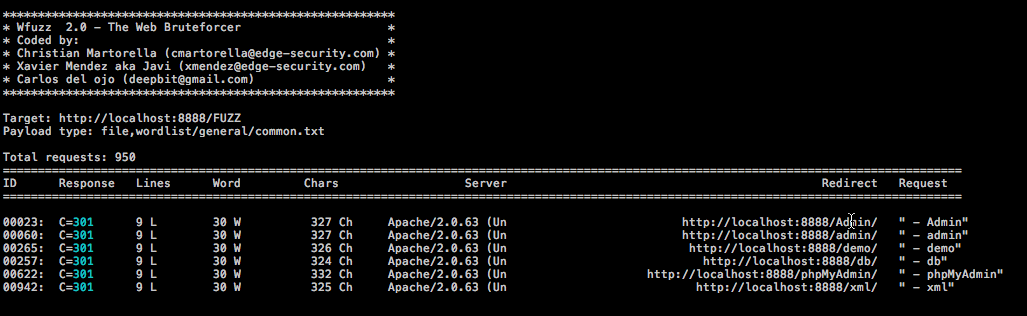
Wfuzz is a tool for bruteforcing Web Applications, it can be used for finding resources not linked (directories, servlets, scripts, etc), bruteforcing GET and POST parameters for different kinds of injections (SQL, XSS, LDAP, etc.), bruteforcing form parameters (user/password), fuzzing, and more.

Wfuzz - The web bruteforcer


Wfuzz is a tool designed for bruteforcing Web Applications, it can be used for finding resources not linked (directories, servlets, scripts, etc), bruteforce GET and POST parameters for checking different kind of injections (SQL, XSS, LDAP,etc), bruteforce Forms parameters (User/Password), Fuzzing,etc.

It's very flexible, here are some functionalities:

  • -Multiple injection points (no limits)
  • -Post, headers and authentication data bruteforcing
  • -Output to HTML
  • -Colored output
  • -Hide results by return code, word numbers, line numbers, etc.
  • -Encodings: sha1,md5,urlencode,uri_hex,utf8,double_urlencode,binary_ascii, and many more.
  • -Cookies fuzzing
  • -Multithreading
  • -Proxy and SOCKS support
  • -Multiple FUZZ capability with multiple dictionaries
  • -Authentication support (Ntlm, Digest,Basic)
  • -Time delays between requests
  • -Verbose output
  • -Flexible payloads (permutation,range,files,usernames,etc)
  • -Recursion (When doing directory bruteforce)
  • -Payload combinations with iterators
  • -Baseline request (to filter results against)
  • -Brute force HTTP methods
  • -Multiple proxy support (each request through a different proxy)
  • -HEAD scan (faster for resource discovery)
  • -Dictionaries tailored for known applications (Weblogic, Iplanet, Tomcat, Domino, Oracle 9i, Vignette, Coldfusion and many more. (Many dictionaries are from Darkraver's Dirb, www.open-labs.org)

It was created to facilitate the task in Web Applications assessments, it's a tool by pentesters for pentesters ;)
One of the strengths of wfuzz is the speed, just try it...

How does it works?
UPDATE: go to the WIKI page in Google code for the latest documentation wiki


Examples

  •  - wfuzz.py -c -z file -f wordlists/commons.txt --hc 404 --html http://www.mysite.com/FUZZ 2> results.html
  • This will bruteforce the site http://www.mysyte.com/FUZZ in search of resources (directories, scripts, files,etc), it will hide from the output the return code 404 (for easy reading the results), it will use the dictionary commons.txt for the bruteforce, and also will output the results to the results.html
    file (with a cool format to work).

  • wfuzz.py -c -z range -r 1-100 --hc 404 http://www.mysite.com/list.asp?id=FUZZ
  • In this example instead of using a file as dictionary, it will use a range from 1-100, and will bruteforce the parameter "id".

  • wfuzz.py -c -z file -f wordlists/commons.txt --hc 404 --html -d "id=1&catalogue=FUZZ" 
               http://www.mysite.com/check.asp 2 > results.html

  • Here you can see the use of POST data, with the option "-d".

  • wfuzz.py -c -z file -f wordlists/commons.txt --hc 404 -R 1 http://www.mysite.com/FUZZ
  • Example of path discovery, using a recursive level of 1 paths.
  • wfuzz.py -c -z file -f wordlists/Injection/SQL.txt -V allvars http://www.mysite.com/res.asp?id=1&name=cars&cat=2
  • Example of Sql injection on every parameter of the request, you can fuzz every parameter with the option "-V allvars".


download coming soon.

RainbowCrack

RainbowCrack

The RainbowCrack tool is a hash cracker that makes use of a large-scale time-memory trade-off. A traditional brute force cracker tries all possible plaintexts one by one, which can be time consuming for complex passwords. RainbowCrack uses a time-memory trade-off to do all the cracking-time computation in advance and store the results in so-called "rainbow tables". It does take a long time to precompute the tables but RainbowCrack can be hundreds of times faster than a brute force cracker once the precomputation is finished.

What's New

[August 9, 2012] RainbowCrack for GPU now support GeForce 600 series GPUs

New Feature:
- Support GPUs of Kepler architecture (GeForce 600 series)
- Up to 15% faster for Fermi architecture GPUs (GeForce 400 series and GeForce 500 series)
- More rainbow table configurations included in free version

RainbowCrack for GPU is the hash cracking program in RainbowCrack hash cracking utilities. It takes advantage of both the effective time-memory trade-off algorithm and powerful computing capability of NVIDIA GPUs.

With two technologies combined, RainbowCrack for GPU is significantly faster than any non-GPU accelerated rainbow table lookup program and any straight GPU brute forcing cracker.

Download RainbowCrack for GPU

Introduction

RainbowCrack is a general propose implementation of Philippe Oechslin's faster time-memory trade-off technique. It crack hashes with rainbow tables.

RainbowCrack uses time-memory tradeoff algorithm to crack hashes. It differs from the hash crackers that use brute force algorithm.

A brute force hash cracker generate all possible plaintexts and compute the corresponding hashes on the fly, then compare the hashes with the hash to be cracked. Once a match is found, the plaintext is found. If all possible plaintexts are tested and no match is found, the plaintext is not found. With this type of hash cracking, all intermediate computation results are discarded.

A time-memory tradeoff hash cracker need a pre-computation stage, at the time all plaintext/hash pairs within the selected hash algorithm, charset, plaintext length are computed and results are stored in files called rainbow table. It is time consuming to do this kind of computation. But once the one time pre-computation is finished, hashes stored in the table can be cracked with much better performance than a brute force cracker.

In this RainbowCrack project, we focus on the development of optimized time-memory tradeoff implementation, and generation of large rainbow tables.

Features of latest RainbowCrack software:
  • Full time-memory tradeoff tool suites, including rainbow table generation, sort, conversion and lookup
  • Support rainbow table of any hash algorithm
  • Support rainbow table of any charset
  • Support rainbow table in raw file format (.rt) and compact file format (.rtc)
  • Computation on multi-core processor support
  • Computation on GPU (via NVIDIA CUDA technology) support
  • Computation on multi-GPU (via NVIDIA CUDA technology) support
  • Runs on 32-bit Windows operating systems
    • Windows XP 32-bit
    • Windows Vista 32-bit
    • Windows 7 32-bit
    • ...
  • Runs on 64-bit Windows operating systems
    • Windows XP 64-bit
    • Windows Vista 64-bit
    • Windows 7 64-bit
    • ...
  • Runs on 32-bit Linux operating systems (x86 only)
  • Runs on 64-bit Linux operating systems (x86_64 only)
  • Unified rainbow table file format on all supported operating systems
  • Command line user interface
  • Graphics user interface (Windows only)


Download

RainbowCrack

The latest version of RainbowCrack software is 1.5.

Version Software Supported operating systems Supported hash algorithm
1.5 rainbowcrack-1.5-win32.zip Windows XP 32-bit
Windows Vista 32-bit
Windows 7 32-bit
...
LM, NTLM, MD5, SHA1, MYSQLSHA1, HALFLMCHALL, NTLMCHALL, ORACLE-SYSTEM, MD5-HALF

Other hash algorithms can be supported via dynamic link library / shared library.
rainbowcrack-1.5-win64.zip Windows XP 64-bit
Windows Vista 64-bit
Windows 7 64-bit
...
rainbowcrack-1.5-linux32.zip Ubuntu 9.10 32-bit and later
Redhat Enterprise Linux 5.5 32-bit and later
openSUSE 11.3 32-bit and later
...
rainbowcrack-1.5-linux64.zip Ubuntu 9.10 64-bit and later
Redhat Enterprise Linux 5.5 64-bit and later
openSUSE 11.3 64-bit and later
...

RainbowCrack for GPU

RainbowCrack for GPU software uses GPU from NVIDIA for computing, instead of CPU. By offloading computation task to GPU, the RainbowCrack for GPU software can be tens of times faster than non-GPU version.

The software package below is a demonstration and only smaller key spaces are supported. RainbowCrack for GPU software with support of larger key space is available for purchase in this page, bundled with ready to work rainbow tables.

Software Supported operating systems Supported configuration
rainbowcrack-gpu-120809.zip Windows XP 32-bit
Windows XP 64-bit
Windows Vista 32-bit
Windows Vista 64-bit
Windows 7 32-bit
Windows 7 64-bit
lm_alpha-numeric#1-7
lm_ascii-32-65-123-4#1-7

ntlm_loweralpha-numeric#1-8
ntlm_loweralpha-numeric#1-9
ntlm_ascii-32-95#1-6
ntlm_ascii-32-95#1-7
ntlm_mixalpha-numeric#1-7
ntlm_mixalpha-numeric#1-8

md5_loweralpha-numeric#1-8
md5_loweralpha-numeric#1-9
md5_ascii-32-95#1-6
md5_ascii-32-95#1-7
md5_mixalpha-numeric#1-7
md5_mixalpha-numeric#1-8

sha1_loweralpha-numeric#1-8
sha1_loweralpha-numeric#1-9
sha1_ascii-32-95#1-6
sha1_ascii-32-95#1-7
sha1_mixalpha-numeric#1-7
sha1_mixalpha-numeric#1-8
rainbowcrack-gpu-110130.zip Windows XP 32-bit
Windows XP 64-bit
Windows Vista 32-bit
Windows Vista 64-bit
Windows 7 32-bit
Windows 7 64-bit
lm_alpha-numeric#1-7

ntlm_loweralpha-numeric#1-7
ntlm_loweralpha-numeric#1-8
ntlm_ascii-32-95#1-6
ntlm_mixalpha-numeric#1-7

md5_loweralpha-numeric#1-7
md5_loweralpha-numeric#1-8
md5_ascii-32-95#1-6
md5_mixalpha-numeric#1-7

sha1_loweralpha-numeric#1-7
sha1_loweralpha-numeric#1-8
sha1_ascii-32-95#1-6
sha1_mixalpha-numeric#1-7

L0phtCrack

L0phtCrack


L0phtCrack attempts to crack Windows passwords from hashes which it can obtain (given proper access) from stand-alone Windows workstations, networked servers, primary domain controllers, or Active Directory. In some cases it can sniff the hashes off the wire. It also has numerous methods of generating password guesses (dictionary, brute force, etc). LC5 was discontinued by Symantec in 2006, then re-acquired by the original L0pht guys and reborn as LC6 in 2009. For free alternatives, consider ophcrack, Cain and Abel, or John the Ripper.


L0phtCrack 6 is packed with powerful features such as scheduling, hash extraction from 64 bit Windows versions, multiprocessor algorithms, and networks monitoring and decoding. Yet it is still the easiest to use password auditing and recovery software available.

Range of Target Systems Software runs On Windows XP and higher. Operates on networks with Windows NT, 2000, XP, Server 2003 R1/R2, Server 2008 R1/R2, on 32- and 64-bit environments, as well as most BSD and Linux variants with an SSH daemon.

Password Scoring
L0phtCrack 6 provides a scoring metric to quickly assess password quality. Passwords are measured against current industry best practices, and are rated as Strong, Medium, Weak, or Fail.

Pre-computed Dictionary Support
Pre-computed password files is a must have feature in password auditing. L0phtCrack 6 supports pre-computed password hashes. Password audits now take minutes instead of hours or days.

Windows & Unix Password Support
L0phtCrack 6 imports and cracks Unix password files. Perform network audits from a single interface.

Remote password retrieval
L0phtCrack 6 has a built-in ability to import passwords from remote Windows, including 64-bit versions of Vista, Windows 7, and Unix machines, without requiring a third-party utility.

Scheduled Scans
System administrators can schedule routine audits with L0phtCrack 6. Audits can be performed daily, weekly, monthly, or just once, depending on the organization's auditing requirements.

Remediation
L0phtCrack 6 offers remediation assistance to system administrators on how to take action against accounts that have poor passwords. Accounts can be disabled, or the passwords can be set to expire from within the L0phtCrack 6 interface. Remediation works for Windows user accounts only.

Updated Vista/Windows 7 Style UI
The user interface is improved and updated. More information is available about each user account, including password age, lock-out status, and whether the account is disabled, expired, or never expires. Information on L0phtCrack 6's current session is provided in an "immediate window" with a reporting tab providing up-to-the-minute status of the current auditing session.


Executive Level Reporting
L0phtCrack 6 has real-time reporting that is displayed in a separate, tabbed interface. Auditing results are displayed based on auditing method, risk severity, and password character sets.

Password Risk Status
Displays risk status in four different categories: Empty, High Risk, Medium Risk, and Low Risk.

Password Audit Method
Displays the completion of all four methods L0phtCrack 6 uses: Dictionary, Hybrid, Precomputed, and Brute Force.

Password Character Sets
Reports the completion of the various character sets being audited, including, Alpha, Alphanumeric, Alphanumeric/Symbol, Alphanumeric/Symbol/International.

Password Length Distribution
Reports the overall length of the discovered password by account.

Summary Report
Password Statistics as Locked, Disabled, Expired, or if the password is older than 180 days. Audit Summary
Number of Accounts cracked and the number of Domains audited.


Foreign Password Cracking
L0phtCrack 6 supports foreign character sets for Brute Force, as well as foreign dictionary files. Pull down menus change for language and character set. L0phtCrack 6 ships with several foreign dictionaries.

Download

L0phtCrack 6 is available as a 15 day free trial download. To continue using it after the trial period you must purchase a license key. we will share free soon.

Click the LC6 icon to download the the L0phtCrack 6 setup program.


Primary Download Site
lc6setup_v6.0.16.exe
(14MB)

MD5 Hash: 38ce9ff56c8f3f118aaa2c46a3acdc3a
SHA1 Hash: 1fa5346c9f245737e0896f2277757eaef069b29e
(to verify hashes, check out md5deep)

Backup Download Site lc6setup_v6.0.16.exe (14MB)

fgdump

fgdump

fgdump is a newer version of the pwdump tool for extracting NTLM and LanMan password hashes from Windows. It is also capable of displaying password histories if they are available. It outputs the data in L0phtCrack-compatible form, and can write to an output file. fgdump attempts to disable antivirus software before running. It then runs pwdump, cachedump (cached credentials dump), and pstgdump (protected storage dump).

Fgdump

A Tool For Mass Password Auditing of Windows Systems

UPDATED 09/18/2008


Version 2.1.0 of fgdump is now available!


09/18/2008:
I've been researching Vista/2008 compatibility, and it appears the password dumping portion works just fine. Cachedump has been problematic, but checking out some posts at oxid.it and a few other locations have given me the drive to get that updated and working for Vista/2008. I am hoping to have that available quite soon.
Also, I'm hoping to eventually get rid of the "dependence" on pwdump and cachedump executables. This will necessitate me changing how fgexec (the service that carries out remote execution) works, but I think it will simplify things quite a bit in the long term. I'm going to finalize Vista/2008 support first, but expect another major revision soon as well that severs ties with the old pwdump6/cachedump code base.
05/07/2008:
Found a couple issues with fgdump, not the least of which is that the remote 64-bit detection was far from perfect. It's still not perfect, but it IS better. Here's the notes for the release:
  • Better 32/64 bit detection. This is not as easy as it sounds, at least not remotely! If someone has a sure-fire way for 100% reliably detecting the target OS, please let me know. In the mean time, if fgdump is unsure, it will report it and default to 32-bit.
  • The -O [32|64] flag will manually override the target OS architecture. So, for example if fgdump is reporting a host as 32-bit and you KNOW it is 64-bit, you can use -O 64 (or vice-versa, of course). Note that this flag will apply to ALL hosts you are dumping! You might want to single out any hosts you need to override.
  • cachedump64.exe was not being deleted from 64-bit targets, which should be fixed now.
04/25/2008:
I love having time to update tools.
I got around to adding 64-bit support to pwdump (1.7.0) and cachedump (technically referring to it as 2.0), which means I needed to build a new version of fgdump. At the same time, I rolled out a few new features which I've either been sitting on, or have been talking about for awhile. And of course, as is typical with new releases, most AV is blind at least for a bit. :) Here's a list of things that have changed:
  • fgdump will now detect 64-bit targets and report them as such
  • 64-bit pwdump and cachedump will be used when the target is detected as 64-bit
  • Fixed a problem when connecting to some Samba servers where RegQueryValueEx would not behave as expected
  • fgdump will now generate a session ID during each run - used to correlate failed logs and regular logs
  • Added command line to log file
  • Added session ID to log file
  • Created a new file with the format (session-id).failed which contains greppable data on failed hosts
  • A log file is always generated of the format (session-id).fgdump-log
  • -l will now override the default log name (see above)
  • Added -a option to prevent tampering with AV. This is useful if you know AV is not picking it up, you want to tamper with the target as little as possible
A couple of notes about the log files. First off, a log file will ALWAYS be generated now, and will contain the date and time of the run. You can override this using -l if you want it to be named something specific. fgdump will now also generate a .failed file, which will contain a list of hosts that were unsuccessful. This file contains greppable records so you can quickly identify what hosts failed, why, and if there are still processes running on the host. This should help during the cleanup phase. The fields in this file are as follows (all separated by "|" characters):
  1. Host IP/name
  2. Windows error number (e.g. 5 for access denied)
  3. 1 if processes are still (possibly) running on the target, 0 if everything should be cleaned up
  4. Text of the error, if available
Additionally, the command line used to invoke fgdump is stored in the log file now. This means, if you pass the password on the command line, IT WILL BE RECORDED IN THE LOG FILE! If this bothers you, please omit the -p parameter and simply provide the password when fgdump asks for it. Please also note that this version has quite a number of changes in it and, while I'm releasing it as non-beta, there is a higher-than-normal chance for bugginess. As usual, please report any issues you find. 
10/26/2007:
It's interesting to me that bugs seem to come in batches. Take, for example, the main bug that prompted the release of 1.7.0 - I received several emails back to back all asking about the same issue, whereas I had not seen that particular problem ever brought up before. As it turns out, the bug had been in the code since day 1, it's just no one had reported it until now. Or I missed their email, which happens periodically.
So 1.7.0 addresses this latest bug, namely error messages of the form something like "Could not connect to \\and\ipc$: Error XX." This was a result of not putting quotation marks around a portion of the pwdump command line, and thus getting weird results from that program. Also in this release is a first pass at disabling Sophos AV, since we actually ran into this at a customer site. Someone sent me a great link to an AV service list, so when I get time, I'll be expanding the program to work with those vendors as well.
Also in this release is a new version of cachedump (dubbed 1.3), with changes submitted by Richie B. The changes cover a larger buffer size (20k instead of 4k, should be useful in big domain environments) as well as adding quotes around the service name, which fixes issues when the service got installed into a path with a space in it. Many thanks to him and other folks who have contributed code, bug reports and feature requests!
09/16/2007:
The short news is that fgdump 1.6.1 is out. It's a minor revision, and addresses issues when running locally (namely "could not connect" types of errors). I also found a printf bug which has been appropriately taken care of.
I haven't had the chance to comment on Defcon yet, but I have to say, I was pretty impressed this year. As usual, I learned a bit, drank way too much and met some cool people. It was great to meet everyone, feel free to stop by and drink our beer anytime. :)
07/25/2007:
We've been having a problem since we moved the site, such that certain links would be broken, images wouldn't show up, that kind of thing. Until we get this resolved permanently, I've made some changes to the URIs to avoid the problem. For those of you direct-linking to the site, you can solve this as well by changing 'www.foofus.net' to 'swamp.foofus.net'. As I said, I hope this is temporary, but drop me a line if you have questions.

See you all at Defcon next week!
06/21/2007:
As promised (though a bit later than I would have liked), I am providing an updated fgdump which is again a bit more evasive with AV (for now, I'm sure that will change). This version also resolves a long-standing problem when running against a local box which would result in an "error 2" for pwdump data. That should no longer be the case. :)
I would really like to thank Neil for helping me work through some fgdump issues - he has been exceptionally helpful in providing detailed error messages, platform information and doing some testing to squash these most recent bugs. Those who have offered help, I cannot possibly thank you enough.
As is the usual case, foofus.net will be in full force at Defcon come the beginning of August. Feel free to drop me a line if you're going as well and would like to chat about the project, make suggestions, etc. I've also been told I make a mean brandy old-fashioned, which is a cocktail for those not familiar with it. :) Also, there have been a few people who have honestly asked me about donating money to the project (!!!). I don't have anything official set up, but you can always PayPal money to 'fizzgig -AT- foofus -DOT- net'. Anything donated goes to the general foofus.net beer fund.
05/30/2007:
So it seems our friends at McAfee have updated their AV signatures and are once again detecting pwdump. Now there are a couple of ways I can get around this certainly, but one stands out as being an easy, quick solution for now. I should have a new release shortly for those who are running into problems with it.
Thanks to Vitaly for pointing this one out to me - I hadn't seen the updated defs yet! Also, to the folks at McAfee and other AV vendors: while I understand you seeing the risks associated with this program, please understand that the majority of usage is by law-abiding folks trying to perform assessments and the like, without any ill intention. Yes, there are a few knobs out there probably attaching it to their trojan/rootkit or whatever, but it seems to me that it's the larger malicious program you should be going after, not this particular utility. The reason I am going to such lengths to avoid AV is not out of a desire to sneak bad programs in, nor to make your life harder. It's simply so that we can continue to do our legitimate job without wrecking servers and making people call us bad names. Just my two cents.
 
** fgdump - A utility for dumping passwords on Windows NT/2000/XP/2003 machines **
Written by fizzgig (fizzgig "AT" foofus "DOT" net)
Greets to all my fellow Foofites: j0m0-Kun (who is the inspiration for this program), phenfen, omi, fade, pmonkey, grunch and of course our namesake foofus.
Many thanks to the awesome folks who created cachedump and pwdump3e as well!
Please let me know if this is useful to you, and I welcome (constructive) comments and suggestions at fizzgig "AT" foofus "DOT" net.
fgdump was born out of frustration with current antivirus (AV) vendors who only partially handled execution of programs like pwdump. Certain vendors' solutions would sometimes allow pwdump to run, sometimes not, and sometimes lock up the box. As such, we as security engineers had to remember to shut off antivirus before running pwdump and similar utilities like cachedump. Needless to say, we're forgetful sometimes...
So fgdump started as simply a wrapper around things we had to do to make pwdump work effectively. Later, cachedump was added to the mix, as were a couple other variations of AV. Over time it has grown, and continues to grow, to support our assessments and other projects. We are beginning to use it extensively within Windows domains for broad password auditing, and in conjunction with other tools (ownr and pwdumpToMatrix.pl) for discovering implied trust relationships.
fgdump is targetted at the security auditing community, and is designed to be used for good, not evil. :) Note that, in order to effectively use fgdump, you're going to need high-power credentials (Administrator or Domain Administrator, in most cases), thus limiting its usefulness as a hacking tool. However, hopefully some of you other security folks will find this helpful.
In quick summary, the main code execution path of fgdump is as follows:
  1. Bind to a remote machine (or a list of machines) using IPC$
  2. Stop AV, if it is installed
  3. Locate file shares exposed on that machine
  4. Find a writable share from the above list, bind it to a local drive
  5. Upload fgexec (used for remote command execution), cachedump
  6. Run pwdump (with password history dump as well)
  7. Run cachedump
  8. Run pstgdump
  9. Delete uploaded files from the file share
  10. Unbind the remote file share
  11. Restart AV if it was running
  12. Unbind from IPC$
Many of the parameters associated with these operations are tweakable via the command line. Run fgdump with no parameters to get the current list of available parameters.
fgdump embeds several programs within its resource tree. This means you only need a single executable rather than dragging out a bunch of them. Of important note are the following:
  • cachedump: This is the popular cached credential program created by the folks at off-by-one.net. Currently, the executable is included verbatim.
  • pwdump6: A heavily modified version of pwdump3e. See the pwdump6 home page for more information on what it does. Basically, it includes password history dumping (per some clever guy's post out on teh Intarweb, and it's less crashy on newer systems.
The source for both of these programs is included in the fgdump source tree, as mandated by the GPL. If you modify fgdump and still use these programs, please continue to distribute the source code for these fine programs.
Also in the source tree:
  • fgexec: A simple service that can be remotely installed that will run a remote executable. Its very similar in function to psservice or sc, just more limited.
  • pwdump6: An updated version of pwdump3e. See its web page here. 
  • pstgdump: A protected storage dumper. This can reveal some VERY interesting information, including saved IE and Outlook Express passwords.
KNOWN ISSUES:
  • None that I am aware of at this time
NOTES:
I removed lsadump2 from fgdump. There were a number of issues that were problematic and, at the end of the day, the amount of useful output it produced just did not justify adding it at this time.
If you have suggestions on terminating a program on a remote machine that DOESN'T INVOLVE INSTALLING A NEW SERVICE (like fgexec or psexec do), let me know. If I can do that, I have a M$AS terminator, but right now I can't execute it, so I have not yet included it with fgdump. This is a work in progress, and the subject of furious research. :)
COMPILING:
The code was all compiled using Visual Studio .NET 2003, and solution/project files for it have been included. Ideally, everything should compile out of the box. :)
DISCLAIMER:
Neither I, nor foofus.net, can take any responsibility for misuse of this program, nor can I guarantee that it will not have adverse affects on certain hosts. By using this program, you assume any and all risk associated with the execution of the program, including but not limited to damage to a system or data loss. In other words,if you break someone's stuff, don't come crying to me. :)


Windows 2000, XP or 2003
Administrative Credentials on Target Systems

Windows 2000, XP or 2003, Vista

Vista cannot currently do cachedumps, and requires enabling Remote Registry and File Sharing

fgdump 2.0.0 no source
(BZIP format, MD5Sum:e27daf1995052308d9591fbd99a3f669)
 (04/25/2008)
fgdump 2.0.0 no source
(ZIP format, MD5Sum:916d6ce72167ed7be07d4a3948c7f93c)
 (04/25/2008)

fgdump 1.7.0 no source
(BZIP format, MD5Sum:ff60e42a0167bd9f0c2733bbb98d14f4)
 (10/26/2007)
fgdump 1.7.0 no source
(ZIP format, MD5Sum:a9ef6f24640997e495179f55cdbcf927)
 (10/26/2007)

fgdump 1.7.0 with source
(BZIP format, MD5Sum:af71edeeb02cd69485512bb6cad49665)
 (10/26/2007)
fgdump 1.7.0 with source
(ZIP format, MD5Sum:f2ef69c293f9b240fddbdb819bbf9076)
 (10/26/2007) fgdump 1.6.1 no source
(BZIP format, MD5Sum:eeaed8b0e47aa877410266d1bfb8bb4d)
 (09/16/2007)
fgdump 1.6.1 no source
(ZIP format, MD5Sum:10cd3aa8f8a2ca4a98521a1f33c10508)
 (09/16/2007)

fgdump 1.6.1 with source
(BZIP format, MD5Sum:5cf610bb41daf2ecabcbbe9607ba8486)
 (09/16/2007)
fgdump 1.6.1 with source
(ZIP format, MD5Sum:023e21cb564a68cd1e96548192798b31)
 (09/16/2007)
fgdump 1.6.0 no source
(BZIP format, MD5Sum:508527308058c30ff1cb7f3de2390b0d)
 (06/21/2007)
fgdump 1.6.0 no source
(ZIP format, MD5Sum:c400adca08fe26381a346e249796b357)
 (06/21/2007)

fgdump 1.6.0 with source
(BZIP format, MD5Sum:23dc3929e94e95d768c6749f038b7783)
 (06/21/2007)
fgdump 1.6.0 with source
(ZIP format, MD5Sum:f319b94638f66a25e13f48e9bcb1a683)
 (06/21/2007)
fgdump 1.5.0 no source
(BZIP format, MD5Sum:649bbc6b72274c77c723bd8f62e9ccbd)
 (05/10/2007)
fgdump 1.5.0 no source
(ZIP format, MD5Sum:f442c05b947aa14106343a94d599f488)
 (05/10/2007)

fgdump 1.5.0 with source
(BZIP format, MD5Sum:71a8eee5397be0a4360d2f63b6af41be)
 (03/26/2007)
fgdump 1.5.0 with source
(ZIP format, MD5Sum:292c24de41bf308e56f092f3b1d7f0d8)
 (03/26/2007) fgdump 1.4.0 (TAR/BZIP format)  (12/08/2006)
fgdump 1.4.0 (ZIP format)  (12/08/2006)
fgdump 1.3.4 (TAR/BZIP format)  (10/12/2006)
fgdump 1.3.4 (ZIP format)  (10/12/2006)
fgdump 1.3.3 (TAR/BZIP format)  (10/04/2006)
fgdump 1.3.3 (ZIP format)  (10/04/2006)
fgdump 1.3.2 (TAR/BZIP format)  (08/02/2006)
fgdump 1.3.2 (ZIP format)  (09/19/2006)
fgdump 1.2.0 (TAR/BZIP format)  (02/22/2006)
fgdump 1.2.0 (ZIP format)  (02/22/2006)
fgdump 1.0.1 (TAR/BZIP format)  (01/04/2006)
fgdump 1.0.1 (ZIP format)  (01/04/2006)


Medusa

Medusa Parallel Network Login Auditor

Medusa is intended to be a speedy, massively parallel, modular, login brute-forcer. It supports many protocols: AFP, CVS, FTP, HTTP, IMAP, rlogin, SSH, Subversion, and VNC to name a few. Other online crackers are THC Hydra and Ncrack. For downloads and more information, visit the Medusa homepage.

What?

Medusa is intended to be a speedy, massively parallel, modular, login brute-forcer. The goal is to support as many services which allow remote authentication as possible. The author considers following items as some of the key features of this application:
  • Thread-based parallel testing. Brute-force testing can be performed against multiple hosts, users or passwords concurrently.
  • Flexible user input. Target information (host/user/password) can be specified in a variety of ways. For example, each item can be either a single entry or a file containing multiple entries. Additionally, a combination file format allows the user to refine their target listing.
  • Modular design. Each service module exists as an independent .mod file. This means that no modifications are necessary to the core application in order to extend the supported list of services for brute-forcing.

Why?

Why create Medusa? Isn't this the same thing as THC-Hydra? Here are some of the reasons for this application:
  • Application stability. Maybe I'm just lame, but Hydra frequently crashed on me. I was no longer confident that Hydra was actually doing what it claimed to be. Rather than fix Hydra, I decided to create my own buggy application which could crash in new and exciting ways.
  • Code organization. A while back I added several features to Hydra (parallel host scanning, SMBNT module). Retro-fitting the parallel host code to Hydra was a serious pain. This was mainly due to my coding ignorance, but was probably also due to Hydra not being designed from the ground-up to support this. Medusa was designed from the start to support parallel testing of hosts, users and passwords.
  • Speed. Hydra accomplishes its parallel testing by forking off a new process for each host and instance of the service being tested. When testing many hosts/users at once this creates a large amount of overhead as user/password lists must be duplicated for each forked process. Medusa is pthread-based and does not unnecessarily duplicate information.
  • Education. I am not an experienced C programmer, nor do I consider myself an expert in multi-threaded programming. Writing this application was a training exercise for me. Hopefully, the results of it will be useful for others.

For a quick comparison of Medusa, Ncrack, and THC-Hydra see: medusa-compare.html

How?

How do I use this thing? Simply running "medusa" without any options will dump all the parameters it accepts along with their respective description. Here are several example uses:
  • Display all modules currently installed:
    % medusa -d
     
    Medusa v1.0-rc1 [http://www.foofus.net] (C) JoMo-Kun / Foofus Networks
    
      Available modules in "." :
      Available modules in "/usr/local/lib/medusa/modules" :
        + mssql.mod :
          Brute force module for M$-SQL sessions : version 0.1.0
        + http.mod :
          Brute force module for HTTP : version 0.1.1
        + ssh.mod :
          Brute force module for SSH v2 sessions : version 0.1.1
        + smbnt.mod :
          Brute force module for SMB/NTLMv1 sessions : version 0.1.1
        + telnet.mod :
          Brute force module for telnet sessions : version 0.1.4
    
  • Display specific options for a given module:
    % medusa -M smbnt -q 
    Medusa v1.0-rc1 [http://www.foofus.net] (C) JoMo-Kun / Foofus Networks
    
    smbnt.mod (0.1.1) JoMo-Kun :: Brute force module for SMB/NTLMv1 sessions
    
    Available module options:
      GROUP:? (DOMAIN, LOCAL*, BOTH)
        Option sets NetBIOS workgroup field.
        DOMAIN: Check credentials against this hosts primary domain controller via this host.
        LOCAL:  Check local account.
        BOTH:   Check both. This leaves the workgroup field set blank and then attempts to check
                the credentials against the host. If the account does not exist locally on the
                host being tested, that host then queries its domain controller.
      GROUP_OTHER:?
        Option allows manual setting of domain to check against. Use instead of GROUP.
      PASS:?  (PASSWORD*, HASH, MACHINE)
        PASSWORD: Use normal password.
        HASH:     Use a NTLM hash rather than a password.
        MACHINE:  Use the machine's NetBIOS name as the password.
      NETBIOS
        Force NetBIOS Mode (Disable Native Win2000 Mode). Win2000 mode is the default.
        Default mode is to test TCP/445 using Native Win2000. If this fails, module will
        fall back to TCP/139 using NetBIOS mode. To test only TCP/139, use the following:
        medusa -M smbnt -m NETBIOS -n 139
    
    (*) Default value
    Usage example: "-M smbnt -m GROUP:DOMAIN -m PASS:HASH"
    
  • The following command instructs Medusa to test all passwords listed in passwords.txt against a single user (administrator) on the host 192.168.0.20 via the SMB service. The "-e ns" instructs Medusa to additionally check if the administrator account has either a blank password or has its password set to match its username (administrator).
    
    % medusa -h 192.168.0.20 -u administrator -P passwords.txt -e ns -M smbnt
    
    Medusa v1.0-rc1 [http://www.foofus.net] (C) JoMo-Kun / Foofus Networks
    
    ACCOUNT CHECK: [smbnt] Host: 192.168.0.20 (1/1) User: administrator (1/1) Password:  (1/7)
    ACCOUNT CHECK: [smbnt] Host: 192.168.0.20 (1/1) User: administrator (1/1) Password: administrator (2/7)
    ACCOUNT CHECK: [smbnt] Host: 192.168.0.20 (1/1) User: administrator (1/1) Password: password (3/7)
    ACCOUNT CHECK: [smbnt] Host: 192.168.0.20 (1/1) User: administrator (1/1) Password: pass1 (4/7)
    ACCOUNT CHECK: [smbnt] Host: 192.168.0.20 (1/1) User: administrator (1/1) Password: pass2 (5/7)
    ACCOUNT CHECK: [smbnt] Host: 192.168.0.20 (1/1) User: administrator (1/1) Password: pass3 (6/7)
    ACCOUNT CHECK: [smbnt] Host: 192.168.0.20 (1/1) User: administrator (1/1) Password: pass4 (7/7)
    
  • The below command-line demonstrates how to execute some of the parallel features of Medusa. Here at least 20 hosts and 10 users are tested concurrently. The "-L" options instructs Medusa to parallelize by user. This means each of the 10 threads targeting a host checks a unique user.
    
    % medusa -H hosts.txt -U users.txt -P passwords.txt -T 20 -t 10 -L -F -M smbnt
    
  • Medusa allows host/username/password data to also be set using a "combo" file. The combo file can be specified using the "-C" option. The file should contain one entry per line and have the values colon separated in the format host:user:password. If any of the three fields are left empty, the respective information should be provided either as a global value or as a list in a file. Medusa will perform a basic parameter check based on the contents of the first line in the file. The following combinations are possible in the combo file:
    • host:username:password
    • host:username:
    • host::
    • :username:password
    • :username:
    • ::password
    • host::password
    The following example will check each entry in the file combo.txt
    % medusa -M smbnt -C combo.txt

    The combo.txt file:
    192.168.0.20:administrator:password
    192.168.0.20:testuser:pass
    192.168.0.30:administrator:blah
    192.168.0.40:user1:foopass

    The following example will check each entry in the file combo.txt against the targets listed in hosts.txt
    % medusa -M smbnt -C combo.txt -H hosts.txt

    The combo.txt file:
    :administrator:password
    :testuser:pass
    :administrator:blah
    :user1:foopass

    Medusa also supports using PwDump files as a combo file. The format of these files should be user:id:lm:ntlm:::. We look for ':::' at the end of the first line to determine if the file contains PwDump output.
  • Resume a Medusa scan. Medusa has the ability to resume a scan which was interrupted with a SIGINT signal (e.g. CTRL-C). For example: Test interrupted with SIGINT
    % ../medusa -M ssh -H host.txt -U users.txt -p password
    Medusa v2.0 [http://www.foofus.net] (C) JoMo-Kun / Foofus Networks

    ACCOUNT CHECK: [ssh] Host: 192.168.0.1 (1 of 11, 0 complete) User: foo (1 of 4, 0 complete) Password: password (1 of 1 complete)
    ACCOUNT CHECK: [ssh] Host: 192.168.0.1 (1 of 11, 0 complete) User: administrator (2 of 4, 1 complete) Password: password (1 of 1 complete)
    ACCOUNT CHECK: [ssh] Host: 192.168.0.1 (1 of 11, 0 complete) User: jmk (3 of 4, 2 complete) Password: password (1 of 1 complete)
    ACCOUNT CHECK: [ssh] Host: 192.168.0.1 (1 of 11, 0 complete) User: bar (4 of 4, 3 complete) Password: password (1 of 1 complete)
    ACCOUNT CHECK: [ssh] Host: 192.168.0.11 (2 of 11, 1 complete) User: foo (1 of 4, 0 complete) Password: password (1 of 1 complete)
    ACCOUNT CHECK: [ssh] Host: 192.168.0.11 (2 of 11, 1 complete) User: administrator (2 of 4, 1 complete) Password: password (1 of 1 complete)
    ALERT: Medusa received SIGINT - Sending notification to login threads that we are are aborting.
    ACCOUNT CHECK: [ssh] Host: 192.168.0.11 (2 of 11, 1 complete) User: jmk (3 of 4, 2 complete) Password: password (1 of 1 complete)
    ALERT: To resume scan, add the following to your original command: "-Z h2u3u4h3."

    Interrupted scan being resumed
    % ../medusa -M ssh -H host.txt -U users.txt -p password -Z h2u3u4h3.
    Medusa v2.0 [http://www.foofus.net] (C) JoMo-Kun / Foofus Networks

    ACCOUNT CHECK: [ssh] Host: 192.168.0.11 (2 of 11, 0 complete) User: jmk (3 of 4, 0 complete) Password: password (1 of 1 complete)
    ACCOUNT CHECK: [ssh] Host: 192.168.0.11 (2 of 11, 0 complete) User: bar (4 of 4, 1 complete) Password: password (1 of 1 complete)
    ACCOUNT CHECK: [ssh] Host: 192.168.0.15 (3 of 11, 1 complete) User: foo (1 of 4, 0 complete) Password: password (1 of 1 complete)

    The following is a brief discription of the resume map:

    h2u3u4h3.
    +--------- First host which was not 100% completed
      +------- First user for host which was not 100% completed
        +----- First user for host which was not started
          +--- First host which was not started
            +- Map ending mark
    

Module specific details:

  • AFP
  • CVS
  • FTP
  • HTTP
  • IMAP
  • MS-SQL
  • MySQL
  • NetWare NCP
  • NNTP
  • PcAnywhere
  • POP3
  • PostgreSQL
  • REXEC
  • RLOGIN
  • RSH
  • SMBNT
  • SMTP-AUTH
  • SMTP-VRFY
  • SNMP
  • SSHv2
  • Subversion (SVN)
  • Telnet
  • VMware Authentication Daemon (vmauthd)
  • VNC
  • Generic Wrapper
  • Web Form

Where?

  Download: medusa-2.1.1.tar.gz
Medusa-gui (Java-based GUI developed by tak and bigmoneyhat)

Install Instructions:

General

The majority of Medusa was written and tested on Linux/Gentoo-based systems. While it has been known to work on variety of operating systems, it is quite possible there may be issues that crop up only on non-Gentoo devices. Of course, there are issues that will probably also show up on Gentoo that have so far been missed...
Medusa should be fairly straight-forward to build: "./configure; make; make install". However, this may result in a somewhat limited installation. To take full advantage of all the brute-forcing goodness that Medusa has to offer, several dependencies must be satisfied. The following table lists out the modules which have additional dependencies. In order for the modules to function, the appropriate header files must be installed on the system when the modules themselves are compiled. Additional module specific information is included within the documentation for each module.


Dependency Homepage Module Notes
OpenSSL http://www.openssl.org HTTP, MSSQL, SMBNT, SSL-based connections
LibSSH2 http://www.libssh2.org SSH LibSSH2 patch provided to address timing issue. Issue appears to be addressed in 0.18.
NCPFS ftp://platan.vc.cvut.cz/pub/linux/ncpfs NCP Use "make install-dev" to install header files.
LibPQ http://www.postgresql.org PostgreSQL
Subversion http://subversion.tigris.org SVN
afpfs-ng http://alexthepuffin.googlepages.com/home AFP Header files may need to be manually installed. Autoconf currently assumes install base of /usr (e.g. /usr/include/afpfs-ng)
It should also be noted that, by default, not all of the modules are built. Incomplete modules or modules which have not been sufficiently tested may be disabled. The "configure" output should identify which modules it will attempt to build. To enable non-default modules, use the "--enable-module-MODULE_NAME" configure option.

Linux/Gentoo

At this time Medusa is not available within Portage. An ebuild for Medusa has been submitted to bugs.gentoo.org, but has not yet made its way into Portage. In the meantime, all of the ebuilds can be used via Portage Overlay. For example, Medusa can be installed via the Gentoo "pentoo" overlay located at trac.pentoo.ch. Additionally, the ebuilds have been included and can also be manually installed.
The following ebuilds have been included within this distribution:
  • /misc/net-analyzer/medusa-2.1.ebuild
Some basic Portage Overlay instructions:

  • Modify /etc/make.conf
    PORTDIR_OVERLAY="/some/directory/"
  • Create the following within the PORTDIR_OVERLAY directory:
    net-analyzer/medusa
  • Place each ebuild and any accompanying files in its respective PORTDIR_OVERLAY directory.
    cd into each directory and execute:
    ebuild name_of_ebuild.ebuild digest
  • Modify /etc/portage/package.keywords
    net-analyzer/medusa ~x86

Other Systems

Medusa has been built and basic tests performed on a variety of default system installations. The following tables includes some notes from these tests.


Operating System Distro/Version Notes
Linux BackTrack 5 (32-bit) Installed: libssl-dev, libncp-dev, libpq-dev, libssh2-1-dev, libgcrypt11-dev, libgnutls-dev, libsvn-dev, libapr1-dev
BackTrack 5R1 (32-bit) Installed: libssl-dev, libncp-dev, libpq-dev, libssh2-1-dev, libsvn-dev
CentOS 6.2 (64-bit) Installed: "Development Tools", openssl-devel, libssh2-devel, postgresql-devel, subversion-devel
Debian 5.0.3 Installed: build-essential, libpcre3-dev, libssl-dev, libncp, libncp-dev, libpq5, libpq-dev, libssh2-1, libssh2-1-dev, libsvn-dev
Fedora 12 Installed: pcre-devel, afpfs-ng-devel, ncpfs-devel, postgresql-devel, libssh2-devel, subversion-devel
openSUSE 11.2 Installed: patterns-openSUSE-devel_C_C++, pcre-devel, ncpfs-devel, libssh2-devel, postgresql-devel, subversion-devel
Slackware 13.0
Ubuntu 8.0.4
Ubuntu 9.10
Ubuntu 11.10 Installed: build-essential, libssl-dev, libncp, libncp-dev, libpq5, libpq-dev, libssh2-1, libssh2-1-dev, libgcrypt11-dev, libgnutls-dev, libsvn-dev
SunOS Solaris 11 x86 Installed: developer-gnu
BSD FreeBSD 7.2 Installed: afpfs-ng, ncpfs, libssh, postgresql, libpq, libsvn
FreeBSD 9.0-CURRENT (32-bit)
OpenBSD 5.0 (64-bit)
Mac OS X OS X 10.6 Installed: MacPorts
OS X 10.7 Installed: HomeBrew
Microsoft Windows Cygwin I have been unable to build the modules under Cygwin. If anyone can figure this out, I'll buy you a beer at the next DefCon.

Who?

This fine piece of buggy software was brought to you by the geeks at Foofus.net. JoMo-Kun was the chief goon and wrote the core of Medusa along with several of the modules. Foofus created the initial design for the loadable modules. Fizzgig provided the networking code, several modules, the loadable module implementation along with also fixing a bunch JoMo-Kun's crappy stuff. pMonkey was a crazy module coding fiend. Last, but certainly not least, Heidi provided the tool's name.

Huh?

If you have questions regarding this application, feel free to contact us. Either send me email directly or join our mailing list foofus-tools. If it breaks, please send a detailed bug report. Even better, send in a patch. I make no claims that this program will do what you want it to. I've been using it during our assessments for years now successfully. Hopefully, others will have similar luck. If you find Medusa useful and want to give something back, please submit new modules, code improvements or just buy any of the Foofus.net goons a beer at the next DefCon.

Click: Download

ophcrack

ophcrack


Ophcrack is a free rainbow-table based cracker for Windows passwords (though the tool itself runs on Linux, Windows, and Mac). Features include LM and NTLM hash cracking, a GUI, the ability to load hashes from encrypted SAM recovered from a Windows partition, and a Live CD version. Some tables are provided as a free download but larger ones have to be bought from Objectif Sécurité.

What is ophcrack?

Ophcrack is a free Windows password cracker based on rainbow tables. It is a very efficient implementation of rainbow tables done by the inventors of the method. It comes with a Graphical User Interface and runs on multiple platforms.

Features:

  • » Runs on Windows, Linux/Unix, Mac OS X, ...
  • » Cracks LM and NTLM hashes.
  • » Free tables available for Windows XP and Vista/7.
  • » Brute-force module for simple passwords.
  • » Audit mode and CSV export.
  • » Real-time graphs to analyze the passwords.
  • » LiveCD available to simplify the cracking.
  • » Dumps and loads hashes from encrypted SAM recovered from a Windows partition.
  • » Free and open source software (GPL).

    Download Windows logo_windows : Download

                        Source logo_linux : Download
    Ophcrack XP LiveCD: cracks LM hashes (Windows XP and earlier) : Download
    md5sum: 2af5b6c23d455310542dba892791fa57
    Ophcrack Vista LiveCD: cracks NT hashes (Windows Vista and 7)    : Download
    md5sum: 79703fec9016e377abb7d8b047e8037b
    Ophcrack LiveCD: does not include any tables (if you already downloaded them) :Download
    md5sum: 721e8421442f1fe9d96af6b91ca7e3bd

THC Hydra

THC Hydra


When you need to brute force crack a remote authentication service, Hydra is often the tool of choice. It can perform rapid dictionary attacks against more then 30 protocols, including telnet, ftp, http, https, smb, several databases, and much more. Like THC Amap this release is from the fine folks at THC. Other online crackers are Medusa and Ncrack. The Nmap Security Scanner also contains many online brute force password cracking modules.

THC-Hydra

A very fast network logon cracker which support many different services. See feature sets and services coverage page - incl. a speed comparison against ncrack and medusa

Current Version: 7.3 Last update 2012-05-23

Screenshots

 
 (1) Target selection

 
 (2) Login/Password setup

 
 (3) Hydra start and output

 [0x00] News and Changelog

        Check out the feature sets and services coverage page - including a speed comparison against ncrack and medusa (yes, we win :-) )

        Read below for Linux compilation notes.
        And there is a new section below for online tutorials.
        

        CHANGELOG for 7.3
        =================
        
        * Hydra main:
            - Added -F switch to quit all targets if one pair was found (for -M)
            - Fixed a bug where hydra would terminate after reporting a successful
              login when an account would accept any password
            - Fixed a bug with very large wordlists (thanks to sheepdestroyer for reporting!)
            - Enhanced the module help
        * configure script:
            - Added fix Oracle library inclusion, thanks to Brandon Archer!
            - Added --nostrip option to prevent binary stripping (requested by Fedora maintainer)
        * Added a Makefile patch by the Debian maintainers to support their
          SecurityHardeningBuildFlags for the wheezy build as requested
        * dpl4hydra: added install directory support
        * All code: message cleanups
        * SNMP module
            - originally already supported write and v2 although this was not in the
              module help output. Added :-)
            - added SNMPv3 MD5/SHA1 authentication support, though beta still
        * HTTP module:
            - fixed HTTP NTLM auth session
            - implemented errata fix for HTTP digest md5-sess algorithm
            - set default path to /
        * HTTP Form module:
            - set default path to /
            - support HTTP/1.0 redirects
            - fix failed condition check when pcre is not used
        * IMAP module: fixed auth detection
        * POP3 module: Updated auth and capability detection
        * Oracle module: fixed bad handling
        * Oracle listener module: fixed hash size handling
        * Telnet/Cisco/Cisco-enable modules: support "press ENTER" prompts
        * FTP module:
            - Fixed a bug where 530 messages were incorrectly handled
            - Clarification for the usage of ftps
        * Mysql module: added patch from Redhat/Fedora that fixes compile problems
        * Added IDN and PCRE support for Cygwin

 You can also take a look at the full CHANGES file


 [0x01] Introduction

 Welcome to the mini website of the THC Hydra project.

 Number one of the biggest security holes are passwords, as every password security study shows.
 Hydra is a parallized login cracker which supports numerous protocols to attack. New modules
 are easy to add, beside that, it is flexible and very fast.

        Hydra was tested to compile on Linux, Windows/Cygwin, Solaris 11, FreeBSD 8.1 and OSX, and
        is made available under GPLv3 with a special OpenSSL license expansion.

 Currently this tool supports:
   AFP, Cisco AAA, Cisco auth, Cisco enable, CVS, Firebird, FTP, HTTP-FORM-GET, HTTP-FORM-POST,
   HTTP-GET, HTTP-HEAD, HTTP-PROXY, HTTPS-FORM-GET, HTTPS-FORM-POST, HTTPS-GET, HTTPS-HEAD,
   HTTP-Proxy, ICQ, IMAP, IRC, LDAP, MS-SQL, MYSQL, NCP, NNTP, Oracle Listener, Oracle SID, Oracle,
   PC-Anywhere, PCNFS, POP3, POSTGRES, RDP, Rexec, Rlogin, Rsh, SAP/R3, SIP, SMB, SMTP, SMTP Enum,
   SNMP, SOCKS5, SSH (v1 and v2), Subversion, Teamspeak (TS2), Telnet, VMware-Auth, VNC and XMPP.

        For HTTP, POP3, IMAP and SMTP, several login mechanisms like plain and MD5 digest etc. are supported.

 This tool is a proof of concept code, to give researchers and security consultants the 
 possiblity to show how easy it would be to gain unauthorized access from remote to a system.

        The program is maintained by van Hauser and David Maciejak.


The Art of Downloading: Source and Binaries
 
 1. The source code of state-of-the-art Hydra: hydra-7.3.tar.gz
    (compiles on all UNIX based platforms - even MacOS X, Cygwin on Windows, ARM-Linux, etc.)

 2. The source code of the stable tree of Hydra in case v7 gives you problems on unusual and old platforms:
    hydra-5.9.1-src.tar.gz

 3. The Win32/Cywin binary release: --- not anymore ---
    Install cygwin from http://www.cygwin.com
    and compile it yourself. If you do not have cygwin installed - how
    do you think you will do proper securiy testing? duh ...

        4. ARM and Palm binaries here are old and not longer maintained:
      ARM:  hydra-5.0-arm.tar.gz
             Palm: hydra-4.6-palm.zip

John the Ripper

John the Ripper


John the Ripper is a fast password cracker for UNIX/Linux and Mac OS X.. Its primary purpose is to detect weak Unix passwords, though it supports hashes for many other platforms as well. There is an official free version, a community-enhanced version (with many contributed patches but not as much quality assurance), and an inexpensive pro version. You will probably want to start with some wordlists, which you can find here.

John the Ripper is free and Open Source software, distributed primarily in source code form. If you would rather use a commercial product tailored for your specific operating system, please consider John the Ripper Pro, which is distributed primarily in the form of "native" packages for the target operating systems and in general is meant to be easier to install and use while delivering optimal performance.

Download one of the latest official free versions:
John the Ripper 1.7.9 (Unix - sources, tar.gz, 848 KB)        - Download
John the Ripper 1.7.9 (Unix - sources, tar.bz2, 701 KB)      - Download
John the Ripper 1.7.9 (Windows - binaries, ZIP, 2029 KB)  -Download

Cain and Abel

Cain and Abel


UNIX users often smugly assert that the best free security tools support their platform first, and Windows ports are often an afterthought. They are usually right, but Cain & Abel is a glaring exception. This Windows-only password recovery tool handles an enormous variety of tasks. It can recover passwords by sniffing the network, cracking encrypted passwords using dictionary, brute-force and cryptanalysis attacks, recording VoIP conversations, decoding scrambled passwords, revealing password boxes, uncovering cached passwords and analyzing routing protocols. It is also well documented.

Disclaimer Of Warranty and Limitation of Liability
THIS SOFTWARE AND THE ACCOMPANYING FILES (IF ANY) ARE PROVIDED "AS IS" WITHOUT WARRANTY OF ANY KIND, EITHER EXPRESS OR IMPLIED, INCLUDING BUT NOT LIMITED TO THE IMPLIED WARRANTIES OF MERCHANTABILITY AND FITNESS FOR A PARTICULAR PURPOSE. THE AUTHOR DOES NOT WARRANT THAT THE FUNCTIONS CONTAINED IN THE SOFTWARE WILL MEET YOUR REQUIREMENTS, OR THAT THE OPERATION OF THE SOFTWARE WILL BE UNINTERRUPTED OR ERROR-FREE, OR THAT ANY DEFECTS DISCOVERED IN THE SOFTWARE WILL BE CORRECTED. FURTHERMORE, THE AUTHOR DOES NOT WARRANT OR MAKE ANY REPRESENTATIONS REGARDING THE USE OR THE RESULTS OF THE USE OF THE SOFTWARE IN TERMS OF ITS CORRECTNESS, ACCURACY, RELIABILITY, OR OTHERWISE. YOU ASSUME ALL RISKS IN USING THE SOFTWARE. NO ORAL OR WRITTEN INFORMATION OR ADVICE GIVEN BY THE AUTHOR OR ANY OF THEIR AUTHORIZED REPRESENTATIVES SHALL CREATE A WARRANTY OR IN ANY WAY INCREASE THE SCOPE OF THIS WARRANTY. IN NO EVENT SHALL THE AUTHOR BE LIABLE FOR ANY DAMAGES WHATSOEVER INCLUDING DIRECT, INDIRECT, INCIDENTAL, CONSEQUENTIAL, LOSS OF BUSINESS PROFITS OR SPECIAL DAMAGES, EVEN IF THE AUTHOR HAS BEEN ADVISED OF THE POSSIBILITY OF SUCH DAMAGES. CERTAIN STATES DO NOT PERMIT EXCLUSIONS OF IMPLIED WARRANTIES OR LIMITATIONS OF LIABILITY, SO THIS DISCLAIMER MAY NOT APPLY TO YOU OR MAY APPLY TO YOU ONLY IN PART. YOU MAY HAVE OTHER LEGAL RIGHTS WHICH VARY FROM STATE TO STATE

Download Cain & Abel v4.9.43 for Windows NT/2000/XP
MD5 - 6FD3C21EF5E301A91E44D2666D9DC90C
SHA1 - 6A77BB40F384CDBCDB520B0765029459ADD78FCF
Click:Download


Aircrack

Aircrack

Like Us Anonops Anonimo


Twitter Delicious Facebook Digg Stumbleupon Favorites More

 
Design by http://www.thepiratesoft.org/ | Bloggerized by Lasantha - Premium Blogger Themes | Hack